RAIN
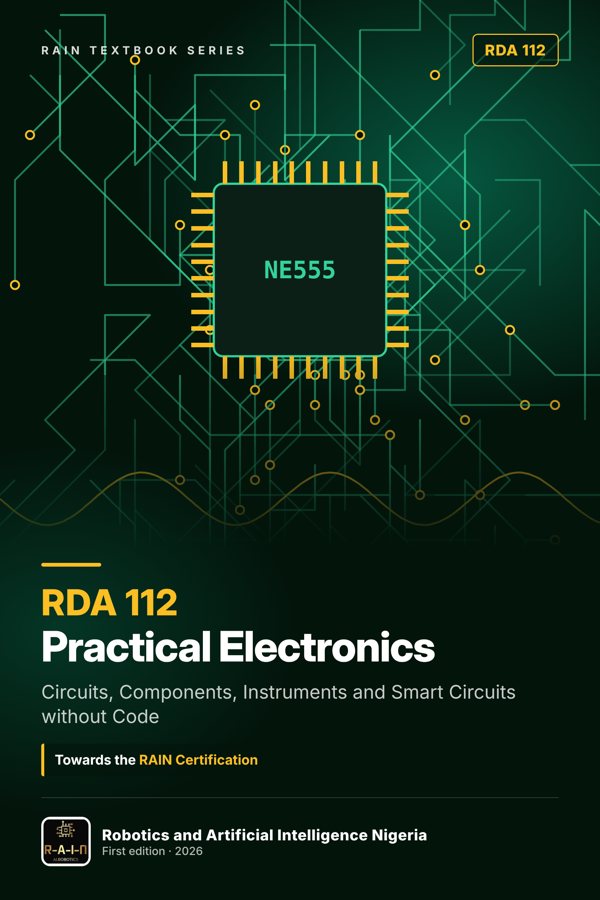
Cover of RDA 112 Practical Electronics

RDA 112

Practical Electronics

Circuits, Components, Instruments and Smart Circuits without Code

Every robot, drone and smart device runs on electronics. Sensors turn light, heat, motion and moisture into voltages; amplifiers, comparators and logic make decisions from them; transistors, relays and motor drivers act on those decisions; and batteries, solar panels and regulators keep the whole system powered. An engineer who understands these circuits can build a working product, find out why one has stopped working, and choose components that survive heat, dust and an unreliable mains supply.

15 chapters in 5 parts, 229 pages. Editor-in-Chief: Olusola Sayeed Ayoola. Published by RAIN, Ibadan, 2026.

Contents

Open a chapter to see its sections. Each chapter ends with a QR code for its free assessment.

1Safety and the Lab Bench
  • 1.1 Electrical safety: shock, fire and ESD
  • 1.2 The bench power supply
  • 1.3 Breadboards and prototyping practice
  • 1.4 Reading schematics
  • 1.5 Case study

Take the Chapter 1 assessment

2Measuring Instruments
  • 2.1 The digital multimeter
  • 2.2 The oscilloscope
  • 2.3 Function generators
  • 2.4 Soldering
  • 2.5 Worked example: measuring a ripple voltage

Take the Chapter 2 assessment

3Charge, Current, Voltage and Power
  • 3.1 SI units and prefixes
  • 3.2 Charge, current and voltage
  • 3.3 Energy and power
  • 3.4 Resistance and Ohm's law
  • 3.5 Series and parallel resistors
  • 3.6 Voltage and current dividers
  • 3.7 Case study

Take the Chapter 3 assessment

4Circuit Analysis Methods
  • 4.1 Kirchhoff's current and voltage laws
  • 4.2 Nodal analysis
  • 4.3 Mesh analysis
  • 4.4 Thevenin and Norton equivalents
  • 4.5 Superposition and maximum power transfer
  • 4.6 Case study: a strain-gauge bridge

Take the Chapter 4 assessment

5Capacitors, Inductors and Transients
  • 5.1 Capacitance
  • 5.2 Inductance
  • 5.3 First-order circuits
  • 5.4 Inductive kickback
  • 5.5 Case study: switching a relay coil

Take the Chapter 5 assessment

6Alternating Current
  • 6.1 Sinusoids, RMS and phase
  • 6.2 Phasors and impedance
  • 6.3 Filters: low-pass, high-pass and cut-off frequency
  • 6.4 Transformers and mains safety
  • 6.5 Case study: filtering a sensor signal

Take the Chapter 6 assessment

7Passive Components
  • 7.1 Resistor types and colour codes
  • 7.2 Capacitor types and ratings
  • 7.3 Potentiometers, LDRs and thermistors
  • 7.4 Case study: a thermistor thermometer and capacitor life

Take the Chapter 7 assessment

8Diodes and Power Supplies
  • 8.1 The PN junction
  • 8.2 Rectifiers and smoothing
  • 8.3 Zener regulation and linear regulators
  • 8.4 LEDs and current-limiting resistors
  • 8.5 Case study: a 5 V supply for a robot controller

Take the Chapter 8 assessment

9Transistors
  • 9.1 Bipolar junction transistors
  • 9.2 MOSFETs for switching loads
  • 9.3 Relays and driving motors
  • 9.4 Darlington pairs and driver ICs
  • 9.5 Case study: switching a pump from a microcontroller

Take the Chapter 9 assessment

10Operational Amplifiers
  • 10.1 The ideal op-amp
  • 10.2 Inverting, non-inverting and voltage-follower amplifiers
  • 10.3 Comparators and Schmitt triggers
  • 10.4 Summing and difference amplifiers
  • 10.5 Real op-amps
  • 10.6 Case study: simulating op-amp circuits

Take the Chapter 10 assessment

11The 555 Timer
  • 11.1 Internal block diagram
  • 11.2 Monostable mode
  • 11.3 Astable mode
  • 11.4 Projects: flashers, tone generators and delay switches
  • 11.5 Case study: simulating the 555

Take the Chapter 11 assessment

12Digital Logic
  • 12.1 Number systems and Boolean algebra
  • 12.2 Logic gates and truth tables
  • 12.3 Karnaugh maps
  • 12.4 Combinational circuits: decoders and multiplexers
  • 12.5 Flip-flops, counters (CD4017) and shift registers
  • 12.6 Logic families and interfacing
  • 12.7 Case study: a tank and pump controller in logic

Take the Chapter 12 assessment

13Sensor-Driven Automation
  • 13.1 Light-activated, temperature-activated and water-level circuits
  • 13.2 Motion detection with PIR modules
  • 13.3 Hysteresis, delays and wear
  • 13.4 Case study: an automatic street light
  • 13.5 Case study: an automatic water-pump controller

Take the Chapter 13 assessment

14Power Systems for Projects
  • 14.1 Batteries: chemistries, capacity and charging
  • 14.2 Solar panels and charge controllers
  • 14.3 DC-DC converters (buck and boost)
  • 14.4 Case study: powering the street light

Take the Chapter 14 assessment

15Printed Circuit Boards
  • 15.1 From schematic to PCB layout (KiCad)
  • 15.2 Track width, clearance and grounding
  • 15.3 Fabrication and assembly
  • 15.4 Troubleshooting methodology
  • 15.5 Case study: laying out the pump controller

Take the Chapter 15 assessment

Order a copy

Printed copies are delivered anywhere in Nigeria or collected at RAIN in Ibadan; digital copies arrive by e-mail with your book owner code. We will reply with the price, delivery cost and payment details.

Schools and companies ordering several copies: put the number you need and we will quote.

Other RAIN textbooks

AIML 101 Building and Deploying AI ApplicationsAIML 111 Data Science with PythonAIML 112 Machine Learning IAIML 211 Machine Learning IIAIML 212 Deep LearningRDA 111 Product Design and Development

All the books