RAIN
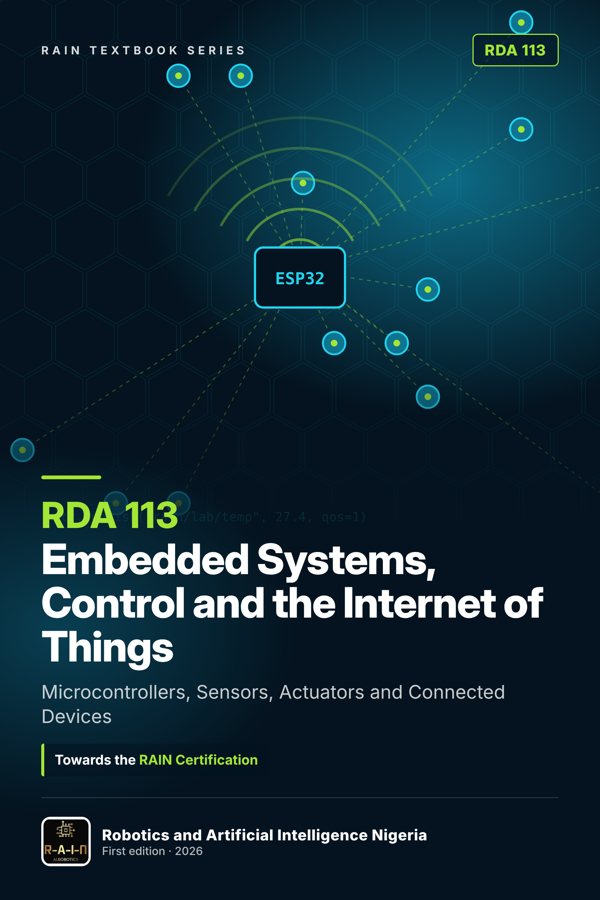
Cover of RDA 113 Embedded Systems, Control and the Internet of Things

RDA 113

Embedded Systems, Control and the Internet of Things

Microcontrollers, Sensors, Actuators and Connected Devices

A microcontroller costs less than a loaf of bread and contains a processor, memory, timers, converters and communication interfaces on one chip. Programmed well, it turns the circuits of RDA 112 into intelligent devices: an irrigation controller that waters by soil moisture and reports to a farmer's phone, a robot that balances and follows a line, an incubator that holds its temperature to a tenth of a degree, a factory sensor that warns before a machine fails. Connected to a network, thousands of such devices form the Internet of Things. This book teaches how to design, program and connect them.

12 chapters in 4 parts, 196 pages. Editor-in-Chief: Olusola Sayeed Ayoola. Published by RAIN, Ibadan, 2026.

Contents

Open a chapter to see its sections. Each chapter ends with a QR code for its free assessment.

1Embedded Systems Fundamentals
  • 1.1 What an embedded system is; real-time constraints
  • 1.2 Microcontroller architecture: CPU, memory, buses and peripherals
  • 1.3 Harvard and von Neumann architectures
  • 1.4 AVR (Arduino), ESP32 and STM32 compared
  • 1.5 Case study: scheduling an ESP32 robot controller

Take the Chapter 1 assessment

2Programming Microcontrollers in C/C++
  • 2.1 The Arduino toolchain and the setup/loop structure
  • 2.2 C/C++ essentials: types, bit manipulation and pointers
  • 2.3 Digital I/O, pull-up resistors and debouncing
  • 2.4 Timing: millis(), delays and non-blocking code
  • 2.5 Interrupts and interrupt service routines
  • 2.6 Case study: a non-blocking controller

Take the Chapter 2 assessment

3Analogue Signals and Conversion
  • 3.1 Sampling and the Nyquist theorem
  • 3.2 ADC resolution and quantisation error
  • 3.3 PWM and duty cycle; DAC behaviour
  • 3.4 Worked example: reading a temperature sensor accurately

Take the Chapter 3 assessment

4Sensors
  • 4.1 Sensor characteristics: range, resolution, accuracy and drift
  • 4.2 Temperature, humidity, light, distance and gas sensors
  • 4.3 IMUs: accelerometers and gyroscopes
  • 4.4 Calibration and filtering (moving average, complementary filter)
  • 4.5 Case study: calibrating and fusing sensors

Take the Chapter 4 assessment

5Actuators and Motor Control
  • 5.1 DC motors and H-bridges
  • 5.2 Servo motors
  • 5.3 Stepper motors and drivers
  • 5.4 Encoders and speed measurement
  • 5.5 Relays and solenoids
  • 5.6 Case study: a motor with an encoder

Take the Chapter 5 assessment

6Communication Buses
  • 6.1 UART
  • 6.2 I²C
  • 6.3 SPI
  • 6.4 Reading a datasheet and timing diagrams
  • 6.5 Case study: buses in practice

Take the Chapter 6 assessment

7Introduction to Control Systems
  • 7.1 Open-loop and closed-loop control; block diagrams
  • 7.2 On-off (bang-bang) control and hysteresis
  • 7.3 Proportional control on a microcontroller
  • 7.4 Case study: temperature control of an incubator

Take the Chapter 7 assessment

8PID Control on Embedded Devices
  • 8.1 The PID law and the role of each term
  • 8.2 Discrete implementation and sampling time
  • 8.3 Integral wind-up and derivative filtering
  • 8.4 Practical tuning (preview of RDA 211)
  • 8.5 Case study: PID for the incubator and a motor

Take the Chapter 8 assessment

9IoT Architecture
  • 9.1 Devices, gateways, cloud and applications
  • 9.2 Wi-Fi, Bluetooth LE, LoRa and GSM compared
  • 9.3 Link budgets
  • 9.4 Power budgets for battery devices
  • 9.5 Case study: choosing a radio for a farm sensor network

Take the Chapter 9 assessment

10IoT Protocols: HTTP and MQTT
  • 10.1 HTTP from a microcontroller: REST requests and JSON
  • 10.2 MQTT: brokers, topics, QoS levels and retained messages
  • 10.3 Securing devices: TLS, credentials and updates
  • 10.4 Worked example: publishing sensor data to a broker

Take the Chapter 10 assessment

11Dashboards and Cloud Platforms
  • 11.1 Node-RED and web dashboards
  • 11.2 A Flask IoT backend with a database
  • 11.3 Cloud IoT services (AWS IoT, Azure IoT Hub)
  • 11.4 Over-the-air updates
  • 11.5 Case study: a backend and a signed update

Take the Chapter 11 assessment

12Home and Industrial Automation
  • 12.1 Smart-home systems
  • 12.2 PLC concepts and ladder logic
  • 12.3 Industrial protocols (Modbus)
  • 12.4 Capstone: a connected monitoring system
  • 12.5 Case study: a ladder program, a Modbus meter and a capstone budget

Take the Chapter 12 assessment

Order a copy

Printed copies are delivered anywhere in Nigeria or collected at RAIN in Ibadan; digital copies arrive by e-mail with your book owner code. We will reply with the price, delivery cost and payment details.

Schools and companies ordering several copies: put the number you need and we will quote.

Other RAIN textbooks

AIML 101 Building and Deploying AI ApplicationsAIML 111 Data Science with PythonAIML 112 Machine Learning IAIML 211 Machine Learning IIAIML 212 Deep LearningRDA 111 Product Design and Development

All the books